

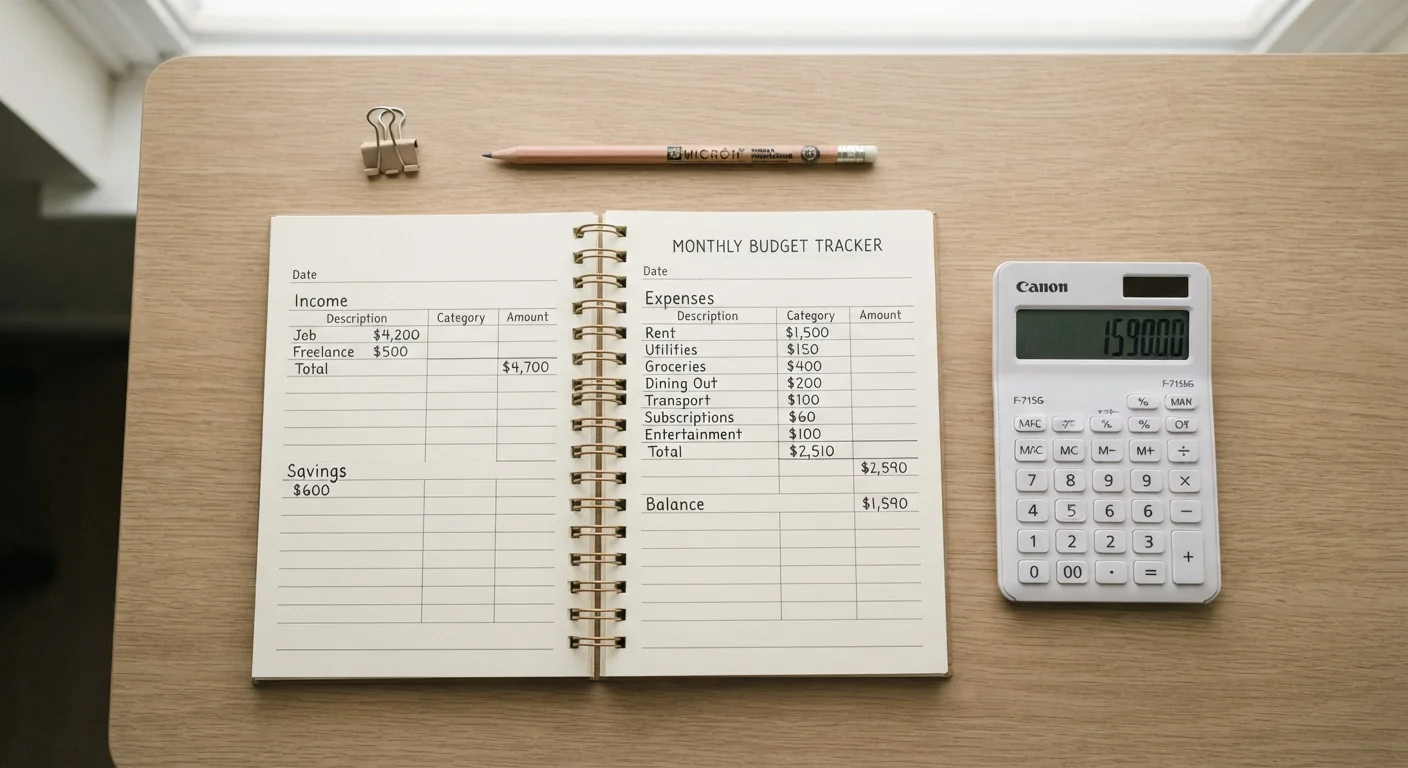
Why a Written Budget Changes the Equation
Most people have a rough sense of what they earn and spend - but a rough sense isn't a plan. Research consistently shows that people who write down a budget, regardless of the method, are more likely to save consistently and less likely to carry high-interest debt. The act of putting numbers on paper (or a spreadsheet) forces intentionality that mental math simply can't replicate.
If you've never budgeted before, the goal of your first month isn't perfection - it's information. You're building a baseline picture of your financial life so that every future decision is grounded in reality. For a deeper look at how budgeting fits into your broader financial picture, see our complete personal budgeting framework.
What you will need
The Six Steps
Follow these steps in order. Each one builds directly on the last, so skipping ahead tends to produce a budget that doesn't hold up past week two.
Calculate your total monthly net income
List every source of money coming in each month - salary, freelance payments, side income, benefits - and record the net amount (after taxes and payroll deductions). If your income varies, use a conservative average from your last three months rather than your highest month.
Add every source together. This single number is your budget ceiling - nothing you plan to spend can exceed it without creating a deficit.
List and categorise every expense
Pull up two to three months of bank and credit card statements and write down every expense. Then sort each into one of three types:
- Fixed: Same amount every month (rent, loan payments, insurance premiums).
- Variable: Fluctuates monthly (groceries, gas, dining, utilities).
- Periodic: Infrequent but predictable (annual subscriptions, car registration, quarterly bills).
For periodic expenses, divide the annual total by 12 to get a monthly equivalent and include it as a line item. Omitting these is one of the most common reasons first budgets fail mid-year.
Apply a baseline spending framework
With your categorised expenses in front of you, apply a general framework to check proportionality. The widely referenced 50/30/20 guideline suggests roughly 50% of net income toward needs (housing, food, utilities, transportation), 30% toward wants (entertainment, dining out, hobbies), and 20% toward savings and debt repayment.
Think of this as a diagnostic tool, not a prescription. High housing costs in expensive metros or significant debt obligations may require a different split. The framework's value is in revealing categories that are disproportionately large - not in enforcing exact percentages.
Assign a dollar amount to every category
Using your actual past spending as the anchor, set a realistic monthly target for each expense category. Work through fixed expenses first (amounts are already set), then variable categories, then your periodic monthly equivalent amounts.
After allocating to expenses, explicitly assign the remaining amount. Common destinations include an emergency fund, retirement contributions, or debt paydown. If you want a structured approach for this allocation, zero-based budgeting - which assigns every dollar a specific job - is worth reviewing.
Check that your total planned spending plus savings equals your total net income. A surplus means room to save more; a deficit means cuts are needed before the month begins.
Track actual spending throughout the month
A budget plan does nothing if you don't compare it against reality. As transactions occur, log them in your chosen tracker and compare each category's running total against its target. You don't need to check daily - two or three times per week is enough to catch overspending before it compounds.
When a category runs over, decide in real time: pull from a less-critical category, or accept the overage and note it. The key is awareness, not punishment. If you're new to intentional spending habits, our guide to spending intentionally covers the mindset shift in detail.
Review results and adjust for next month
At the end of the month, compare every budgeted amount against actual spending. Note which categories were accurate, which were over, and which had money left over. Ask two questions for each variance: Was this a one-time anomaly, or will it repeat? Was the original target realistic?
Adjust next month's budget based on what you learned - not what you wish you'd spent. Over two to three months, your budget will converge toward a realistic picture of your actual financial life, making every subsequent month easier to manage. Pair this review with the monthly budget reset checklist for a structured end-of-month routine.
Once you've completed your first month, use our monthly budget reset checklist to review results and refine your plan going forward.
Choosing a Tracking Method That Sticks
The best tracking method is whichever one you'll actually use. Three broad options exist, each with real trade-offs:
- Spreadsheet: Full control, zero cost, but requires manual data entry. Good for detail-oriented people who want complete customisation.
- Budgeting apps: Many link directly to bank accounts and auto-categorise transactions, reducing friction significantly. Trade-offs include privacy considerations and occasional miscategorisation. See a balanced comparison in our cash budgeting vs. digital tracking apps article.
- Pen and notebook: Simple, offline, and distraction-free. Works well for people who find screens counterproductive for financial tasks.
If the spending-compartment concept appeals to you, the envelope budgeting method adapted for digital banking is worth exploring alongside your tracker of choice.
Consistency Beats Complexity
A simple budget you review regularly outperforms a sophisticated one you abandon after two weeks. Start with broad categories (housing, food, transport, savings, everything else) and add granularity only once the habit is established. Reducing friction at the start dramatically increases the chance you'll still be budgeting six months from now.
Common First-Budget Pitfalls
Even well-intentioned first budgets fall apart for predictable reasons. Watch for these:
- Forgetting periodic expenses: Annual subscriptions, car registration, and seasonal costs feel invisible until they hit. Divide annual totals by 12 and include them as a monthly line item.
- Budgeting income before tax: Always use net (after-tax, after-deductions) income. Budgeting gross income inflates what's available and leads to shortfalls.
- Setting categories too tight: Under-budgeting groceries or gas because you want the numbers to look good is one of the most common mistakes. Use actual past spending, not aspiration, for baseline figures.
- No buffer category: Life produces small unexpected costs constantly. A modest miscellaneous or buffer line - even $25-$50 - prevents small surprises from derailing your plan.
Building an emergency fund alongside your budget creates a critical safety net. Our article on how emergency funds and budgets work together explains the relationship clearly.
This article provides general financial education and is not personalised financial advice. Consider consulting a qualified financial adviser for guidance specific to your situation.
The content provided on our blog site traverses numerous categories, offering readers valuable and practical information. Readers can use the editorial team’s research and data to gain more insights into their topics of interest. However, they are requested not to treat the articles as conclusive. The website team cannot be held responsible for differences in data or inaccuracies found across other platforms. Please also note that the site might also miss out on various schemes and offers available that the readers may find more beneficial than the ones we cover.