

Why Checked Bags Are a Budget Problem Worth Solving
Checked bag fees are one of the most predictable and avoidable travel costs. At rates commonly ranging from $30 to $70 per bag each way on domestic flights - and similar or higher on some international routes - a traveler checking one bag roundtrip on four trips a year could easily spend $240 to $560 annually on luggage alone. That's real money that goes directly toward nothing except the inconvenience of waiting at baggage claim.
Beyond the direct fees, checked bags introduce risk: delays, misrouted luggage, and the time cost of baggage claim add friction to every trip. Skipping checked bags entirely removes that category of stress completely. It also opens up fare flexibility - you can fly on Spirit, Frontier, or other basic-economy options without the checked-bag surcharge making them uneconomical.
For a fuller picture of where travel costs pile up and how to structure a realistic trip budget, see our guide on building a travel budget that holds up on the road. Baggage is one line item - it's rarely the only one worth scrutinizing.
Carry-on bag (within airline limits)
Your primary luggage - must fit within the overhead bin or under-seat dimensions specified by your carrier.
Personal item bag (backpack or tote)
Holds everyday-access items like a laptop, documents, snacks, and anything you'll need during the flight.
Packing cubes (set of 3-4)
Compress and organize clothing categories so the bag stays structured and items are easy to locate.
Travel-size laundry soap or sheets
Enables sink washing or laundromat use mid-trip, reducing the clothing volume you need to carry.
Luggage scale
Confirms your bag meets weight limits before you leave home, avoiding gate surprises.
What You Actually Need to Make Carry-On-Only Work
The mechanics of carry-on-only travel are straightforward once the mindset shifts from what might I need to what will I actually use. The biggest obstacle isn't bag size - it's the psychological insurance of packing for every theoretical scenario.
What you will need
The clothing strategy matters more than the bag itself. A neutral-palette wardrobe of interchangeable pieces, combined with a mid-trip laundry plan, does more to enable carry-on-only travel than any compression system or ultra-packable gear. Our companion piece on what earns its place in your bag covers the decision-making framework in more depth.
Plan Your Laundry Before You Land
Carry-on-only travel works best when laundry is treated as a planned activity, not an afterthought. Before departure, identify whether your accommodations have laundry access or whether a nearby laundromat is an option. Building one laundry stop into a week-long trip lets you pack roughly half the clothing you'd otherwise bring.
It's also worth reading an honest take on the trade-offs: carry-on-only travel has real limits depending on trip length, destination climate, and activity type. Going in with clear expectations keeps the system from feeling like deprivation.
Step-by-Step: Building Your Carry-On Packing System
The following steps walk through how to build a reliable carry-on-only system from scratch - starting with your current habits, not an idealized packing list.
Verify Carry-On Limits Before Every Flight
Carry-on size and weight restrictions differ by airline, fare class, and even aircraft type. Budget carriers in particular often enforce stricter limits or charge fees for oversized cabin bags. Always check the specific carrier's current policy - not a general rule of thumb - before you pack and before you arrive at the gate.
Audit your current packing habits
Before changing what you pack, understand where the bloat comes from. After your last trip, how much of what you checked came home unworn or unused? Most travelers consistently overpack in three categories: clothing "just in case" options, duplicate toiletries, and electronics or cables they never touch.
Write down everything you packed last time, then mark what you actually used. That list is your real packing baseline - not the hypothetical version.
Apply a structured clothing formula
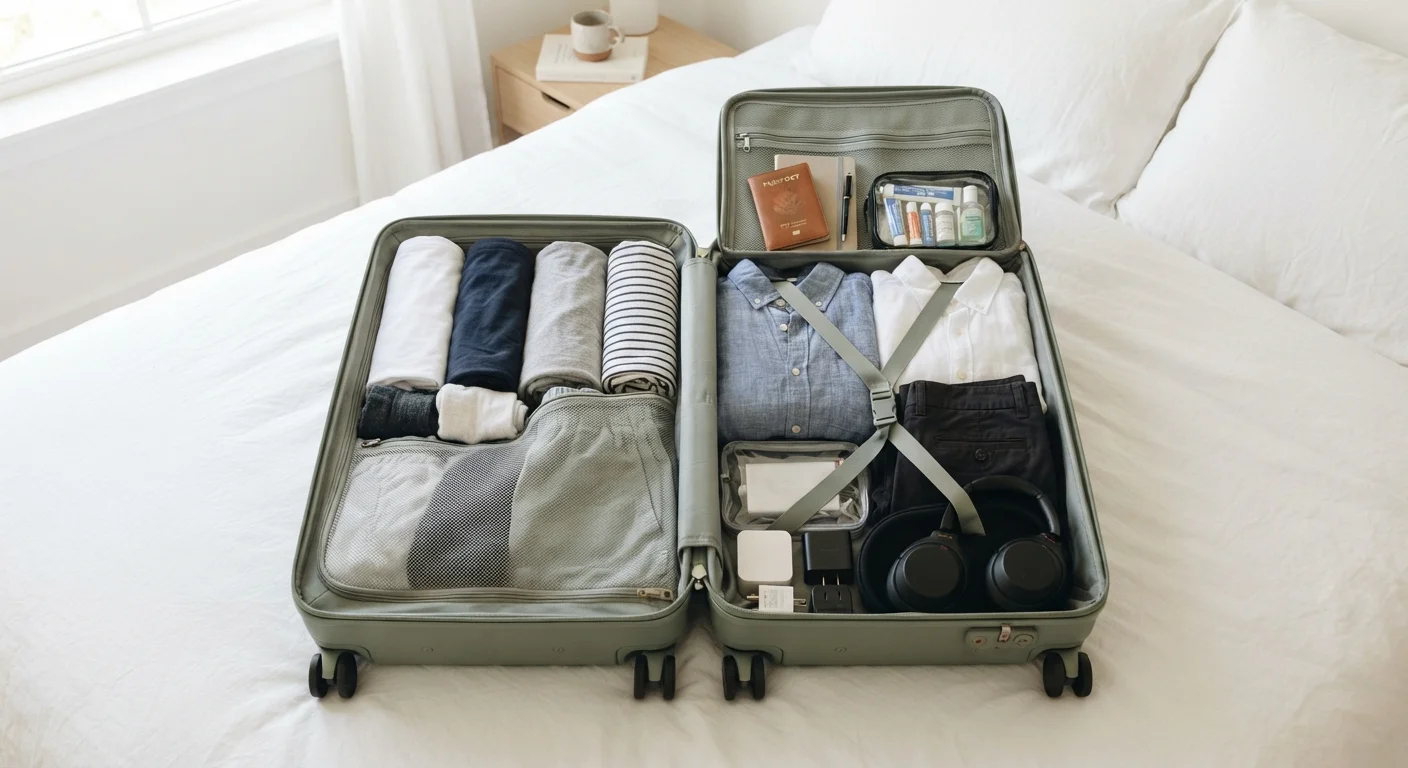
The 5-4-3-2-1 framework gives you a reliable ceiling for clothing on trips up to 10-14 days: 5 pairs of socks and underwear, 4 tops, 3 bottoms, 2 pairs of shoes, 1 lightweight jacket or layer. Adjust modestly for trip length, but resist the urge to add full outfit sets - that's where checked bags start.
Choose a neutral color palette (navy, grey, black, olive, white) so every top works with every bottom. Mixing patterns or bright statement pieces locks you into specific combinations and inflates what you feel you need to bring.
Build a laundry plan into your itinerary
Carry-on-only packing doesn't require extreme minimalism - it requires a laundry strategy. If you plan to wash clothes once during a seven-day trip, you can cut your clothing count nearly in half. Check whether your accommodation has a washer, a laundry bag service, or whether a laundromat is nearby.
Even sink-washing a few items overnight - particularly socks and lightweight tops - extends your range significantly without adding weight or bulk.
Consolidate and downsize toiletries
Toiletries are dense and heavy. Stick to TSA-compliant containers (3.4 oz / 100 ml per liquid) and bring only what your destination won't easily supply. Most hotels and many rental accommodations provide shampoo, conditioner, and soap - no need to duplicate those.
Solid toiletries (bar shampoo, solid sunscreen, toothpaste tablets) eliminate liquid restrictions entirely and take up less space. A single clear quart-size bag should hold everything you need.
Pack and weigh before you leave home
Once everything is packed, weigh the bag. Most airlines allow 15-22 lbs (7-10 kg) for carry-ons, but limits vary - know yours specifically. If you're over, remove items rather than redistribute weight between bags, since personal items also have limits on many carriers.
Do a final physical check: lift the bag onto a simulated overhead bin height (a countertop or high shelf) to confirm you can manage it without assistance. A bag you can't lift comfortably becomes a problem at every connection.
Once this system is in place, it integrates naturally with broader pre-trip planning. The budget traveler's pre-trip checklist covers what else to lock in before departure - documents, bookings, and financial prep that protect your budget from the start.
Carry-on discipline is one piece of a larger spending strategy. For more ways to reduce costs without cutting the experience, see lesser-known traveler money-saving strategies.
The content provided on our blog site traverses numerous categories, offering readers valuable and practical information. Readers can use the editorial team’s research and data to gain more insights into their topics of interest. However, they are requested not to treat the articles as conclusive. The website team cannot be held responsible for differences in data or inaccuracies found across other platforms. Please also note that the site might also miss out on various schemes and offers available that the readers may find more beneficial than the ones we cover.