

Our Verdict
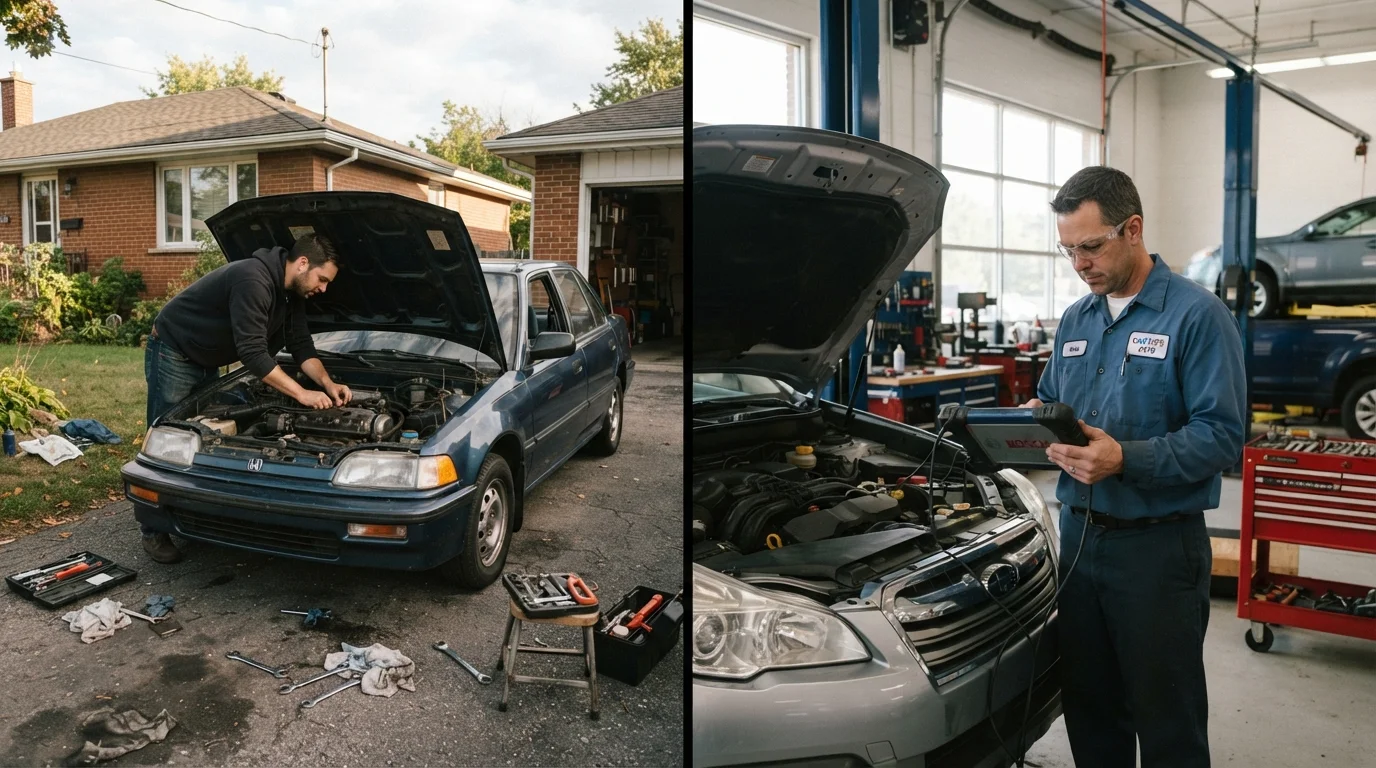
Neither all-DIY nor all-shop servicing is the right answer for every driver. The smartest approach treats DIY as a tool for well-defined, low-risk tasks and reserves professional service for anything involving safety systems, specialized diagnostics, or work where an error compounds into a costly failure. Getting this split right is one of the most effective ways to manage lifetime vehicle costs.
| Best for | Recommended |
|---|---|
| Drivers with basic mechanical aptitude and proper tools | DIY for routine maintenance |
| Anyone dealing with brakes, airbags, or advanced electronics | Professional shop |
| Drivers who want to minimize total ownership costs over time | Hybrid approach |
| Those without tools, workspace, or a reliable vehicle for diagnosis | Professional shop |
The Real Question: Risk vs. Reward
The decision to DIY or visit a shop isn't just about saving money - it's about accurately matching the task to the skill level, tools, and consequences involved. A botched oil change is a nuisance; a botched brake job is a safety emergency. That asymmetry in consequences should drive the decision more than labor cost alone.
For context, the Car Costs & Savings pillar covers a range of strategies for reducing what you spend over a vehicle's life. Where maintenance falls on the DIY-vs-shop spectrum is one of the highest-leverage decisions in that picture. See also our broader look at keeping maintenance costs in check over a vehicle's lifetime for a scheduling-first approach.
| DIY Maintenance | Professional Shop | |
|---|---|---|
| Labor cost | None (your time) | Typically $80-$150/hr depending on region |
| Parts cost | Retail; can match or beat shop pricing | Shop markup on parts is common |
| Tool investment | Required upfront; amortizes over time | None - included in labor rate |
| Diagnostic capability | Limited without professional scan tools | Full diagnostic equipment available |
| Safety risk | Higher on complex or safety-critical tasks | Lower - technicians trained and insured |
| Best suited for | Filters, fluids, wipers, battery | Brakes, suspension, electrical, transmission |
| Warranty considerations | May affect warranty if done incorrectly | Shop work typically carries a labor guarantee |
What Most Drivers Can Reasonably Handle at Home
Several routine maintenance items require minimal tools, carry a low margin for consequential error, and are well-documented in most owner's manuals. These include:
- Engine air filter replacement - typically a tool-free swap taking under 10 minutes.
- Windshield wiper blades - straightforward clip-and-slide installation.
- Cabin air filter - usually behind the glove box; no mechanical knowledge required.
- Oil and filter changes - feasible for drivers with a jack, stands, and the correct oil specification from their manual. Disposing of used oil responsibly (at an auto parts store or recycling center) is required by law in most states.
- Battery terminal cleaning or battery replacement - manageable with basic safety precautions; disconnect negative terminal first.
- Tire inflation and rotation - inflation is a no-tool task; rotation requires a jack and lug wrench but follows a straightforward pattern.
The key discipline here is using the right specifications. Your owner's manual lists the correct oil viscosity, filter type, and torque values - these matter. Substituting based on shelf availability rather than spec is a common and avoidable mistake.
Start With Your Owner's Manual
Before attempting any maintenance task, locate the relevant section in your owner's manual for the exact specification - oil grade, filter part number, torque setting, and service interval. Manufacturer specifications override anything printed on a parts package or suggested by a general-purpose guide. If your manual has been lost, most automakers publish them as free PDFs on their official websites.
Jobs That Belong in a Shop
Some tasks are beyond the driveway not because they're mysterious, but because the consequences of error are severe, the required equipment is expensive, or the job interacts with safety-critical systems.
- Brake system work - Pad replacement can be DIY-adjacent for experienced hands, but rotor machining, caliper rebuilding, and brake line work require precision and proper bleeding equipment. Errors here are life-threatening.
- Steering and suspension components - Ball joints, tie rods, and wheel bearings require alignment afterward and carry significant handling consequences if installed incorrectly.
- Timing belt or timing chain service - Engine synchronization is exacting work; a mistimed engine can cause catastrophic internal damage.
- Airbag system (SRS) components - Federal regulations exist around airbag systems, and inadvertent deployment during DIY work can cause serious injury.
- Transmission service beyond fluid changes - Internal transmission work requires specialized tools and a controlled environment.
- Advanced electrical or module programming - Modern vehicles rely on networked control modules that require dealer-level or professional scan tools to configure correctly.
A multi-point inspection at a shop can surface hidden issues that a DIY visual check will miss - worth doing at least annually even if you handle routine maintenance yourself.
The Hidden Costs on Both Sides
DIY carries upfront tool costs that can quickly erode apparent savings on a single job. A quality floor jack, jack stands, torque wrench, and oil drain kit can run $150-$300 before you've turned a bolt. Those costs amortize over time, but first-timers should calculate total outlay, not just parts cost.
Shop costs aren't monolithic either. Labor rates vary significantly by region, shop type (dealership vs. independent), and specialization. Deferred maintenance compounds into expensive repairs - as detailed in why skipping routine maintenance costs far more than the service itself. Paying for a professional job done correctly the first time is often cheaper than a DIY attempt that damages a related component.
There's also the diagnostic dimension. Many check-engine codes require an OBD-II scanner to read, but interpreting what a code means - and verifying it's the root cause rather than a symptom - is where professional expertise earns its fee. The complete driver's reference covers how to evaluate repair estimates and communicate clearly with technicians.
Don't Let 'Almost Done' Become a Liability
A partially completed repair that gets put back on the road can be more dangerous than the original problem. If a DIY job reveals a complication you're not equipped to handle - a stripped bolt, a seized component, a broken clip - stop and seek professional help rather than improvising a fix. Vehicles with known incomplete repairs should not be driven until the issue is properly resolved.
The content provided on our blog site traverses numerous categories, offering readers valuable and practical information. Readers can use the editorial team’s research and data to gain more insights into their topics of interest. However, they are requested not to treat the articles as conclusive. The website team cannot be held responsible for differences in data or inaccuracies found across other platforms. Please also note that the site might also miss out on various schemes and offers available that the readers may find more beneficial than the ones we cover.