

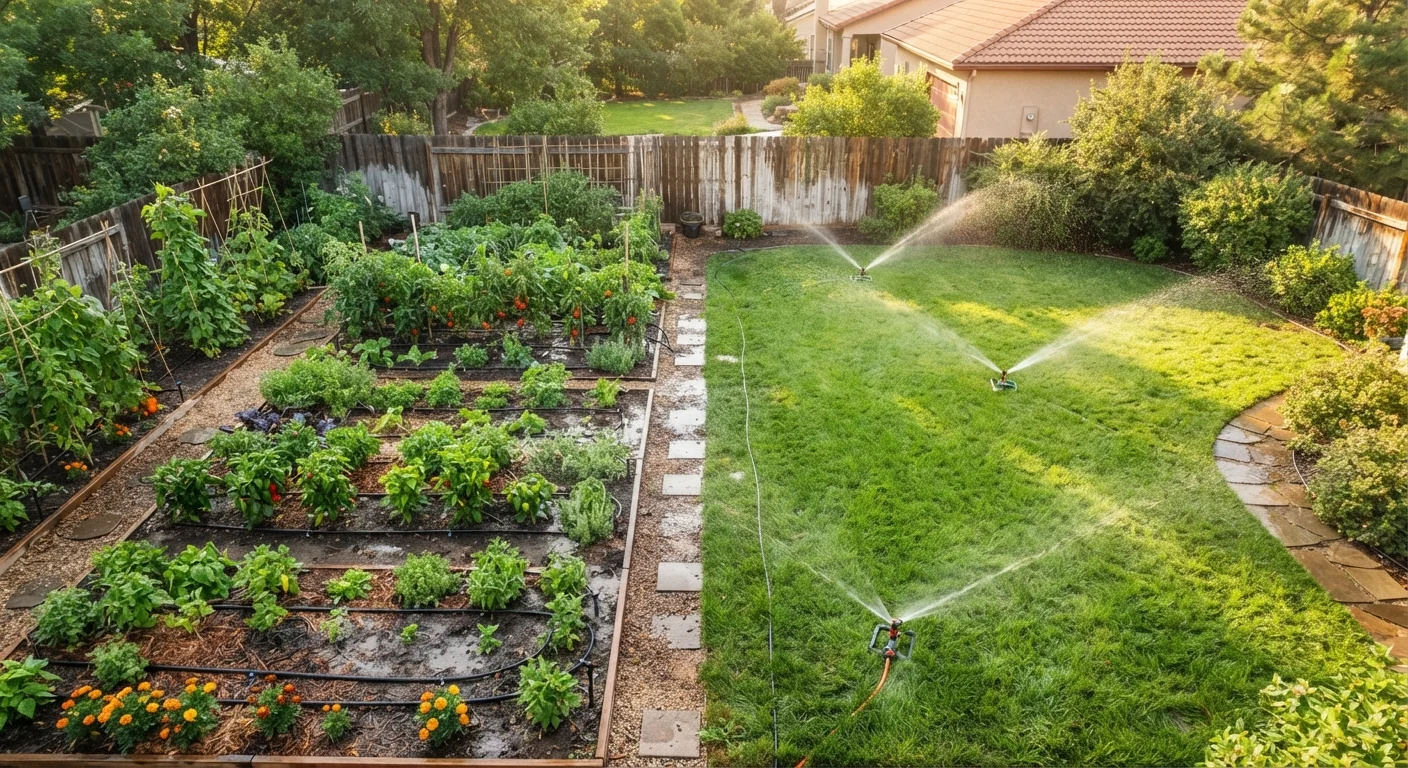
Option A
Drip Irrigation
The precision, low-volume choice for garden beds and rows.
Best for: Homeowners with vegetable gardens, raised beds, shrubs, or trees who want to minimize evaporation and runoff.
Option B
Sprinkler Systems
The broad-coverage classic for lawns and open landscapes.
Best for: Homeowners with established turfgrass, large open yards, or ground covers requiring uniform surface moisture.
How Each System Delivers Water
Understanding the mechanics behind each method clarifies why efficiency numbers differ so dramatically.
Drip irrigation routes water through a network of flexible tubing and emitters placed at or just below the soil surface, near individual plant bases. Water seeps out slowly - typically 0.5 to 2 gallons per hour per emitter - saturating the root zone directly. Because water never reaches the air in quantity, evaporation losses are minimal and foliage stays dry, which reduces fungal disease pressure.
Sprinkler systems propel water through the air in arcs or rotating patterns, wetting both soil and plant surfaces. Coverage is broad and relatively uniform, making sprinklers the practical choice for turfgrass. However, water droplets traveling through the air are subject to evaporation, and any wind present during a watering cycle can push water well outside the intended zone. Watering during cooler morning hours reduces - but doesn't eliminate - these losses.
For a deeper look at how watering timing and technique affect plant health, see common watering myths debunked.
| Criterion | Drip Irrigation | Sprinkler Systems |
|---|---|---|
| Water efficiency | 90-95% (root-zone delivery) | 50-75% (varies by design) |
| Best application | Beds, borders, row crops | Turfgrass, large open areas |
| Upfront installation | Lower; DIY-friendly | Higher; often requires a contractor |
| Ongoing water cost | Lower per cycle | Higher per equivalent area |
| Maintenance needs | Emitter checks, filter cleaning | Head adjustments, winterization |
| Foliage disease risk | Low (soil-level delivery) | Moderate (wet leaves) |
| Coverage flexibility | Plant-specific, less flexible | Broad, easily adjusted by head |
| Permit requirements | Usually none for surface drip | Often required for in-ground work |
Water Efficiency: The Numbers That Matter
Efficiency claims deserve scrutiny. The frequently cited figure is that drip systems are 90-95% efficient compared to 50-70% for overhead sprinklers - meaning for every gallon used, drip puts more of it where plants can actually absorb it. Those figures come from agricultural extension research and reflect real-world conditions including evaporation, overspray, and runoff.
90-95%
Typical drip irrigation efficiency rate
Agricultural extension research consistently places drip systems at 90-95% efficiency under field conditions.
50-75%
Typical sprinkler efficiency range
Efficiency varies widely based on head type, pressure, scheduling, and wind exposure at time of use.
30-50%
Potential water savings switching to drip
US EPA WaterSense program estimates homeowners can cut landscape water use by 30-50% with efficient irrigation practices.
Sprinkler efficiency isn't fixed, though. A well-maintained system with matched precipitation heads, pressure regulation, and a smart controller can perform considerably better than the low end of that range. The gap narrows when sprinklers are properly designed and programmed - but it rarely closes entirely for non-turf plantings.
Drip systems also lose efficiency over time if emitters clog - a common problem with mineral-rich water. Flushing lines seasonally and installing filters at the source keeps output consistent. Combining drip with a good layer of mulch compounds the savings: reduced soil-surface evaporation means even less water is needed per cycle. Our guide to mulching garden beds correctly walks through the depth and material choices that make the biggest difference.
Installation, Cost, and Maintenance
Neither system is free to install, and upfront cost should be weighed against long-term operating savings.
Drip systems require more planning per zone: emitter placement depends on individual plant spacing, root spread, and soil type. Materials - tubing, emitters, pressure regulators, and filters - are relatively inexpensive, but a larger garden may need many individually placed components. DIY installation is very achievable for most homeowners. Maintenance involves annual inspection for clogged or misaligned emitters and winterization in freeze-prone climates.
In-ground sprinkler systems involve trenching, backflow preventer installation, and zone design - work that typically requires a licensed irrigation contractor in most states. Permit requirements vary by municipality; check with your local building department before starting any underground installation. Operating costs depend heavily on zone scheduling and local water rates.
For raised bed gardeners evaluating which system fits their setup, the trade-offs of raised bed gardening article covers drainage and moisture considerations that affect your irrigation choice.
Both systems pay dividends when paired with a timer or smart controller that adjusts for rainfall and seasonal changes. Without automation, even the most efficient hardware is undermined by overwatering habits.
Matching the System to Your Yard
No single system wins universally - the right answer depends on what you're growing and how your yard is laid out.
- Vegetable gardens and raised beds: Drip is the clear choice. Precise delivery reduces disease, and the ability to water at soil level keeps paths dry and workable.
- Established turfgrass: Sprinklers remain the practical standard. Drip tubing across a lawn is impractical to install, maintain, or aerate around.
- Mixed landscapes (shrubs, perennials, trees): A hybrid approach often works well - drip for planting beds, sprinklers for turf zones - run on separate timer programs.
- Slopes and sandy soils: Drip reduces runoff risk significantly; sprinklers on a slope can send water downhill before it infiltrates.
- Arid climates and water-restricted areas: Drip's efficiency advantage is most valuable here, and local water agencies may offer rebates for conversion.
If you're rethinking your yard's overall design to reduce maintenance alongside water use, low-maintenance landscaping strategies offer plant and layout ideas that complement either irrigation approach.
Check for Local Water Rebates
Many municipal water utilities and state water agencies offer rebates for converting from overhead sprinklers to drip irrigation. Rebate amounts and eligibility rules vary widely, so contact your local water provider directly to find out what's available in your area before you buy materials or hire a contractor.
The content provided on our blog site traverses numerous categories, offering readers valuable and practical information. Readers can use the editorial team’s research and data to gain more insights into their topics of interest. However, they are requested not to treat the articles as conclusive. The website team cannot be held responsible for differences in data or inaccuracies found across other platforms. Please also note that the site might also miss out on various schemes and offers available that the readers may find more beneficial than the ones we cover.