

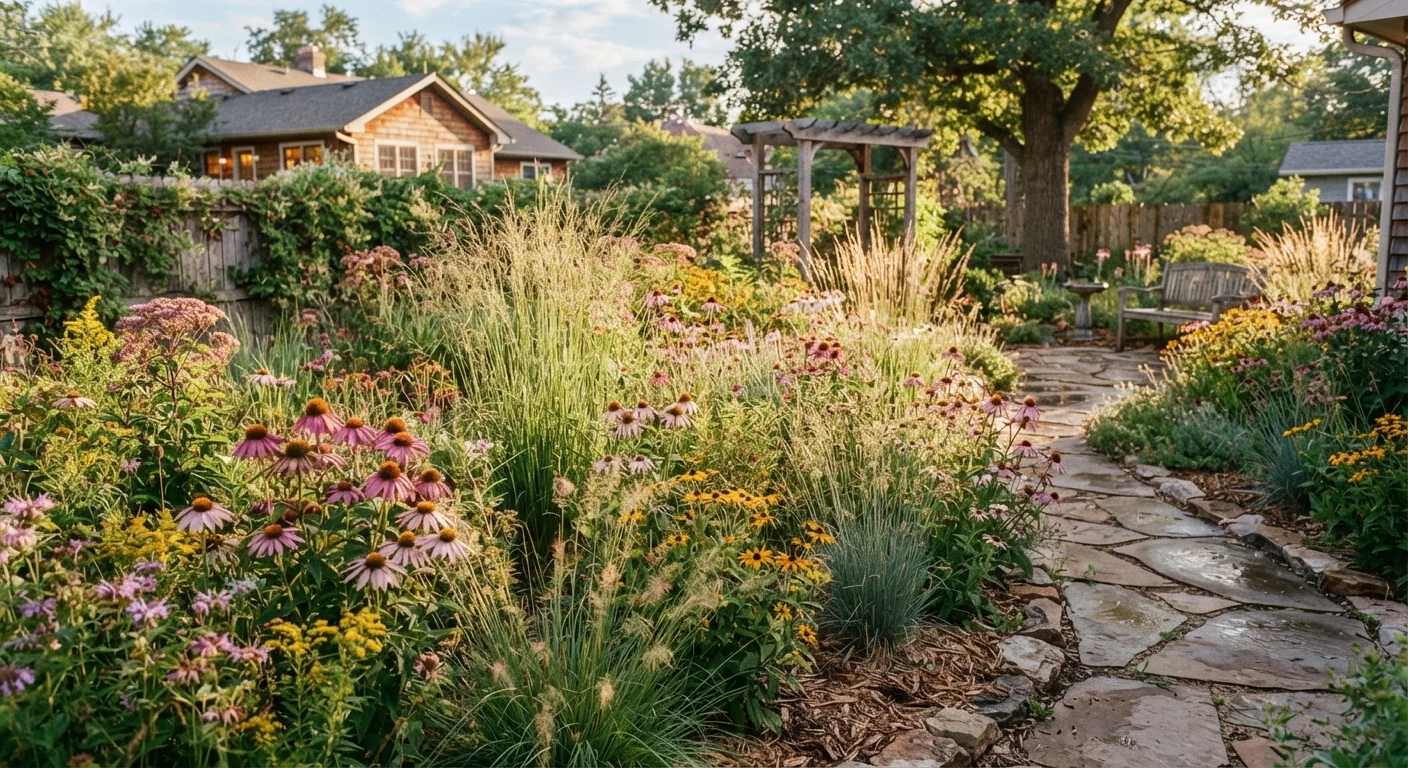
What Makes a Plant 'Native' - and Why It Matters
The word native gets used loosely in garden centers, but it has a precise meaning: a species that established itself in a region through natural processes - not human introduction - and co-evolved with the local ecosystem over millennia. That evolutionary history is what gives native plants their practical advantages.
A non-native ornamental planted in your yard exists outside the ecological relationships it evolved within. It may need soil adjustments to survive, struggle with local pest pressures it has no resistance to, or require irrigation far beyond what local rainfall provides. Natives, by contrast, have already solved those problems through adaptation.
Importantly, nativity is not a national label. A plant native to the Southeast is ecologically exotic in the Mountain West. When selecting natives, the relevant unit is your ecoregion - the specific combination of climate, soil type, and native plant community where you live. Your state's cooperative extension service is one of the most reliable resources for matching plants to your specific zone.
The Real Cost Difference: Inputs Over Time
Exotic ornamentals are not inherently more expensive to purchase. The cost gap emerges in ongoing maintenance. Consider what many popular non-native landscape plants require to survive outside their native range: supplemental irrigation through dry months, soil amendments to compensate for pH mismatches, synthetic fertilizers to make up for nutrient relationships their roots never evolved to exploit, and repeated pesticide applications against pests that native predators would otherwise control.
~30%
Of US household water use goes to landscaping
According to the US Environmental Protection Agency, landscape irrigation accounts for roughly 30% of household water use nationally, with a significant portion considered excess or inefficient.
4x
More bee species supported by native vs. non-native plantings
Research published in peer-reviewed ecology journals has found that native plant species support significantly higher numbers of native bee species compared to exotic ornamentals of similar appearance.
1-3 seasons
Typical establishment period for native perennials
Most horticultural guidance and extension research indicates native perennials and shrubs require one to three growing seasons before becoming largely self-sufficient in their adapted region.
None of these inputs is free. Water bills, fertilizer applications, and pest treatments accumulate season after season. Native plants, once past the establishment phase (typically one to three growing seasons), dramatically reduce or eliminate most of these recurring costs. Their root systems are often far deeper than those of exotic alternatives, allowing them to access groundwater during dry spells that would stress shallower-rooted ornamentals.
For homeowners interested in low-maintenance landscaping strategies, native plantings are one of the most structurally sound foundations you can build from.
Ecological Benefits That Have Practical Value
The ecological argument for natives is well documented, but it has direct practical payoffs for homeowners that often go unacknowledged. Native plants support local pollinator populations - bees, butterflies, moths - that are essential for vegetable gardens and fruit trees. A yard planted with regionally appropriate natives can meaningfully increase pollinator activity without any additional effort.
Native plantings also tend to build healthier soil biology over time. Their root systems contribute organic matter, support mycorrhizal fungal networks, and improve soil structure - reducing compaction and improving drainage. This is complementary to other good soil management practices; for example, pairing a native planting bed with good mulching technique amplifies moisture retention. See our guide to mulching garden beds correctly for specifics on material depth and placement.
Birds also benefit from natives in ways that matter to gardeners: many native shrubs and trees produce berries or seeds that feed birds, which in turn provide natural pest control. This web of relationships simply doesn't function the same way with plants that evolved on another continent.
How to Transition Practically Without Starting Over
A wholesale yard conversion is rarely practical or necessary. The most workable approach is gradual replacement - identifying the highest-maintenance spots in your landscape and substituting a well-chosen native when an existing plant struggles or dies. Over two or three seasons, this produces meaningful change without major disruption or expense.
A few principles that help the transition go smoothly:
- Start with problem areas. Spots where exotic plants repeatedly fail - poor drainage, dry shade, clay soil - are exactly where a well-matched native will outperform. Don't fight the site; find a native that fits it.
- Cluster natives together. Native plantings perform better and look more intentional in groups rather than scattered individually. This also makes mulching and maintenance more efficient.
- Manage expectations during establishment. The first season of a native planting often looks underwhelming. The saying in native gardening - "first year sleep, second year creep, third year leap" - reflects genuine growth patterns as root systems develop before visible top growth accelerates.
If you're weighing whether to incorporate raised bed structures into your landscape alongside native plantings, it's worth understanding the trade-offs involved - our article on raised bed gardening advantages and drawbacks covers the real costs and maintenance considerations honestly.
Match the Plant to the Microsite, Not Just the Region
Within your yard, conditions vary: a sunny south-facing slope, a shaded corner under a tree, and a low-lying spot that stays moist are three distinct microsites. Native plants are adapted to regional conditions broadly, but matching species to your yard's specific light, moisture, and soil conditions is what separates a plant that survives from one that genuinely thrives. Take time to observe your yard's conditions before selecting species.
Frequently Asked Questions
Generally, yes - once established, native plants typically require less supplemental watering, fewer fertilizers, and less pest intervention than exotic species not adapted to local conditions. The upfront cost of native plants can vary, but ongoing input costs tend to be lower over time.
Most native perennials and shrubs take one to three growing seasons to fully establish their root systems. During this period, some supplemental watering may still be needed, especially in dry climates. After establishment, they typically become largely self-sufficient.
Absolutely. Many native species - coneflowers, black-eyed Susans, native ferns, ornamental grasses - are visually striking and widely used in designed landscapes. Thoughtful planning can produce a yard that is both beautiful and ecologically functional.
No. A gradual approach works well. Many homeowners introduce natives into existing beds over several seasons, replacing underperforming or high-maintenance exotic plants as they go. A full replacement is not necessary to gain meaningful benefits.
Local native plant nurseries, botanical garden plant sales, and native plant societies are reliable sources. Your state's cooperative extension service can also provide region-specific plant lists and guidance on appropriate species for your ecoregion.
The content provided on our blog site traverses numerous categories, offering readers valuable and practical information. Readers can use the editorial team’s research and data to gain more insights into their topics of interest. However, they are requested not to treat the articles as conclusive. The website team cannot be held responsible for differences in data or inaccuracies found across other platforms. Please also note that the site might also miss out on various schemes and offers available that the readers may find more beneficial than the ones we cover.