

The Hidden Reason Your Fertilizer Isn't Working
You've watered carefully, added fertilizer, chosen good varieties - yet your tomatoes are yellowing and your lawn looks patchy. The problem may not be what you're putting in the soil, but whether the soil can deliver it. Soil pH acts as a gatekeeper: when it's off, even nutrient-rich soil locks out the minerals plants need most.
Nitrogen, phosphorus, potassium, iron, and manganese all have narrow pH windows in which they become soluble enough for roots to absorb. Outside those windows, nutrients bind to soil particles and become chemically unavailable. You can add bags of fertilizer and still see deficiency symptoms if the pH is wrong. This is why testing before amending is essential - it's the foundational step in the complete guide to growing a healthy lawn.
6.0-7.0
Optimal pH range for most garden plants
University extension services broadly recommend this range for vegetables, lawn grasses, and common ornamentals.
4.5-5.5
Preferred pH for acid-loving plants
Blueberries, azaleas, and rhododendrons require significantly more acidic conditions than typical garden beds.
~$10-$20
Typical cost of a home soil test kit
Basic kits available at garden centers; cooperative extension lab tests may cost a similar amount but provide more detailed results.
How pH Affects Nutrient Availability
The relationship between pH and nutrients isn't linear - it's nuanced. Phosphorus, one of the most critical nutrients for root development and flowering, becomes nearly unavailable in very acidic soils (below 5.0) and again in highly alkaline soils (above 7.5). Iron and manganese, important for chlorophyll production, are more soluble at lower pH values; in alkaline soils, deficiency causes a characteristic yellowing between leaf veins called iron chlorosis.
Conversely, excessively acidic soils can allow aluminum and manganese to reach concentrations that become toxic to sensitive plants. Understanding this balance explains why blanket advice like "add more fertilizer" so often fails: the chemistry of the soil determines what's actually accessible to plant roots.
Soil pH and Organic Matter Work Together
Organic matter - compost, aged manure, leaf mold - helps buffer soil against dramatic pH swings by improving the soil's cation exchange capacity. This means well-amended soils are more forgiving of minor imbalances. Improving organic content is a good strategy alongside any targeted pH correction, and it benefits soil structure and drainage at the same time.
Testing Your Soil: Simple, Affordable, Necessary
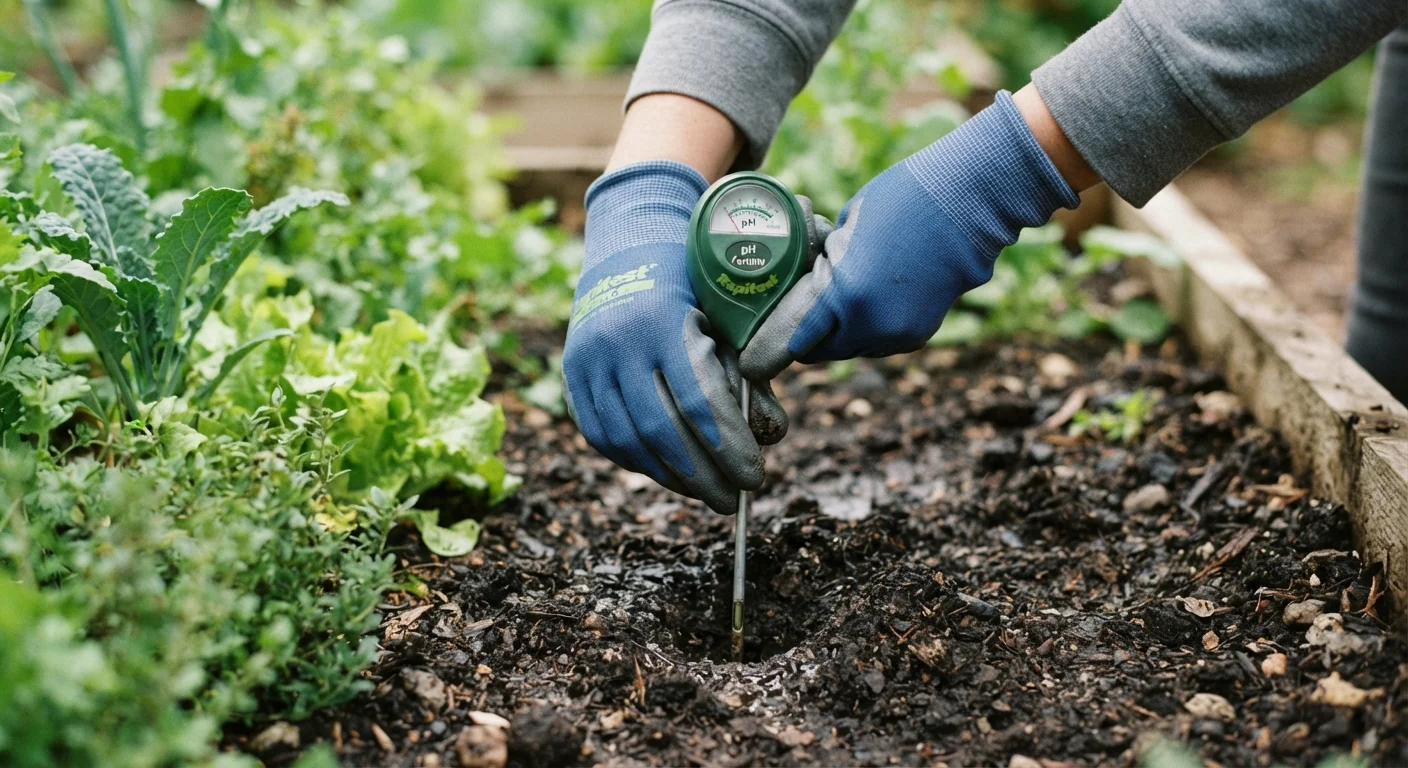
Home pH test kits rely on a color indicator that changes hue based on soil acidity - they're inexpensive and easy to use. Digital pH meters offer slightly more precision and are reusable over many seasons. For the most comprehensive picture, your local cooperative extension service (a free resource run through land-grant universities) can perform lab analysis that includes pH, organic matter content, and specific nutrient levels for a modest fee.
Collect samples from several spots in the garden and mix them together for a representative reading. Test at root depth - about 4 to 6 inches - rather than from the surface, where conditions can differ significantly. If you're planting acid-loving plants like blueberries or azaleas alongside lawn grass, test each area separately, since their ideal ranges don't overlap.
Adjusting pH: What Works and What Takes Time
Raising pH (making soil less acidic) is typically done with ground agricultural limestone, often called garden lime. Calcitic lime adds calcium; dolomitic lime adds both calcium and magnesium. Lowering pH (making soil more acidic) is commonly achieved with elemental sulfur or acidifying fertilizers. Wood ash raises pH quickly but also supplies potassium - something to account for in your overall soil management plan.
The critical point most gardeners miss: pH adjustment is slow. Amendments need to react with soil chemistry and microbial activity, a process that can take several months. Applying too much too quickly can overshoot your target. Always start with the quantity your test results recommend, retest after a full growing season, and adjust from there. Pairing pH correction with sound mulching practice also helps stabilize soil conditions over time - see our guide on mulching your garden beds the right way for details on how organic mulch influences soil chemistry gradually.
Regional Patterns and Native Plant Advantages
Where you live matters enormously. Rainfall leaches alkaline minerals from soil over time, so the humid Eastern US tends toward acidic soils, while arid Western regions more commonly have alkaline or neutral conditions. Local geology also plays a role - areas with limestone bedrock often have naturally higher pH. Understanding your regional baseline helps you anticipate the scale of any amendment needed.
One practical strategy for cost-conscious gardeners is choosing plants adapted to your soil's natural pH rather than fighting to change it. Native plants, in particular, have evolved alongside local soil chemistry and often perform well without amendment. Learn more about this approach in our article on why native plants outperform exotic ornamentals. And remember, getting pH right works in tandem with other fundamentals - even a perfectly balanced soil struggles when watering myths are quietly harming your plants.
Frequently Asked Questions
Most vegetables thrive between 6.0 and 7.0 pH, with 6.5 often cited as a reliable sweet spot. Some crops, like blueberries, prefer more acidic conditions around 4.5-5.5. Always check the preferences of the specific plants you're growing.
Inexpensive pH test kits and digital meters are widely available at garden centers. For the most accurate results, collect soil from multiple spots in your garden at a depth of 4-6 inches, then follow the kit's instructions. Your local cooperative extension service may also offer low-cost lab testing.
Ground limestone (lime) is commonly used to raise pH in acidic soils; elemental sulfur or acidifying fertilizers can lower pH in alkaline soils. Changes are gradual and may take several months to a season to take full effect. Always retest before adding more amendment.
Extreme pH levels can severely stress or kill plants by locking out essential nutrients or allowing toxic mineral concentrations to build up. Mild imbalances more commonly cause slow growth, yellowing leaves, and poor yields rather than immediate plant death.
Testing every two to three years is sufficient for most home gardens. Test more frequently if you've recently added amendments, if you're establishing a new bed, or if plants continue to struggle despite good care.
The content provided on our blog site traverses numerous categories, offering readers valuable and practical information. Readers can use the editorial team’s research and data to gain more insights into their topics of interest. However, they are requested not to treat the articles as conclusive. The website team cannot be held responsible for differences in data or inaccuracies found across other platforms. Please also note that the site might also miss out on various schemes and offers available that the readers may find more beneficial than the ones we cover.