

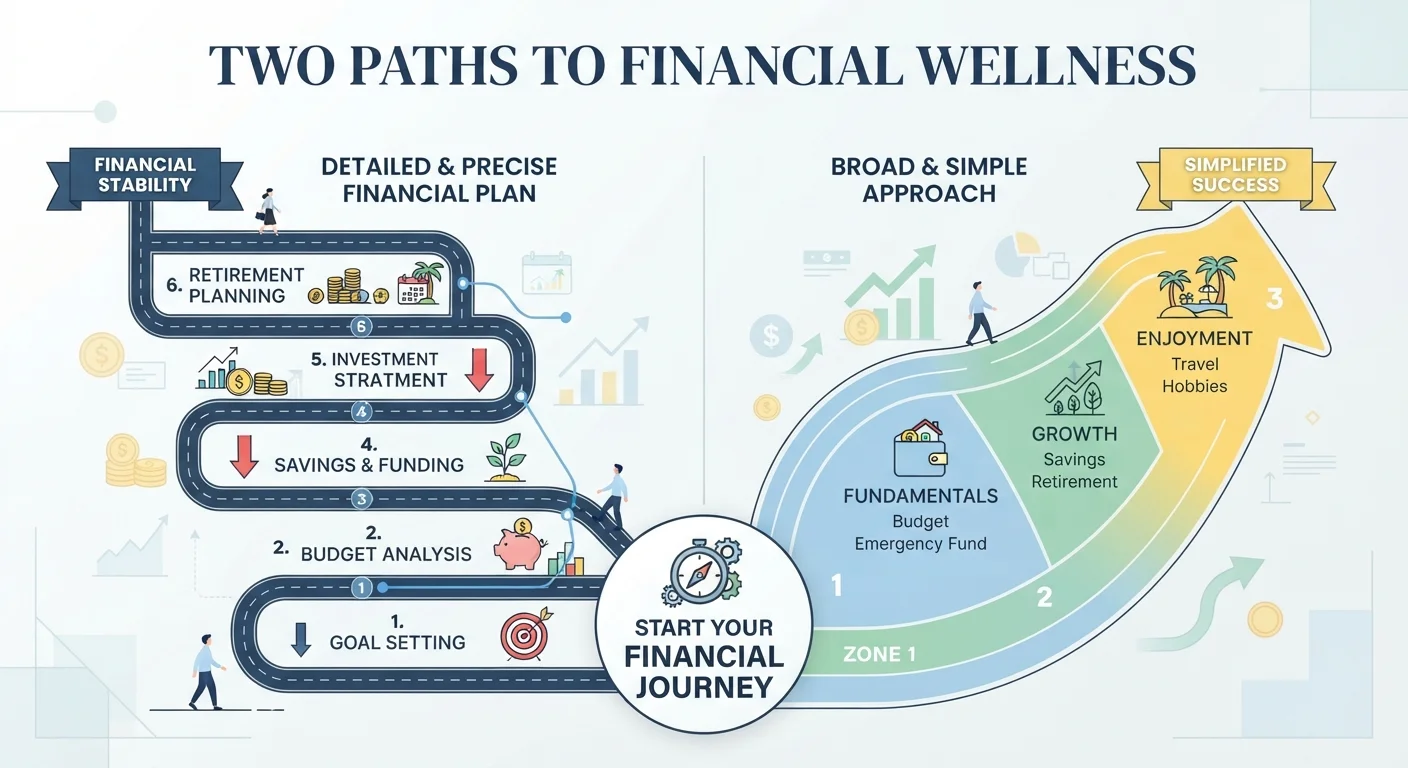
Option A
Zero-Based Budgeting (ZBB)
The meticulous, dollar-by-dollar approach.
Best for: People who want granular control over every spending category and are willing to invest time each month to plan and track.
Option B
The 50/30/20 Rule
The streamlined, percentage-driven framework.
Best for: People who want a simple, low-maintenance structure that provides guardrails without requiring detailed category tracking.
How Each Framework Is Structured
Understanding what each method actually requires day-to-day is the first step to choosing one you'll stick with. For a broader foundation, see our complete personal budgeting framework.
Zero-Based Budgeting
With ZBB, you start each budget period - typically a month - from scratch. You list your expected income, then assign every dollar to a specific category: rent, groceries, transportation, savings, entertainment, and so on. The goal is that income minus all allocations equals zero. That doesn't mean spending everything; it means every dollar has a named purpose, including dollars directed to savings or investments. Learn more in our detailed look at zero-based budgeting in practice.
The 50/30/20 Rule
Popularized broadly as a rule of thumb for after-tax income, the 50/30/20 rule divides your take-home pay into three categories: roughly 50% toward needs (housing, utilities, groceries, insurance, minimum debt payments), 30% toward wants (dining out, subscriptions, travel, hobbies), and 20% toward savings and additional debt repayment. There's no line-item tracking required - only broad category awareness.
| Criterion | Zero-Based Budgeting | 50/30/20 Rule |
|---|---|---|
| Setup complexity | High - requires full category mapping | Low - three buckets only |
| Monthly maintenance | Ongoing - reset and adjust each month | Minimal - monitor broad percentages |
| Best income type | Variable or irregular income | Stable, predictable income |
| Spending visibility | Very granular by category | Broad - needs, wants, savings |
| Flexibility mid-month | Requires reallocation between categories | Absorbs changes within buckets easily |
| Goal-specific saving | Strong - named savings categories | Moderate - lump 20% savings target |
| Learning curve | Steeper | Gentle - accessible for beginners |
Where Each Method Excels - and Where It Struggles
Both frameworks have genuine strengths, but each comes with trade-offs worth understanding before you commit.
Zero-Based Budgeting: Strengths and Limitations
ZBB excels at revealing exactly where money is going. Because every category is named and deliberate, it's harder for small expenditures to erode your plan invisibly. It also adapts well to irregular income - each month's budget reflects actual dollars available, not an assumed average.
The downside is the time investment. Building a ZBB requires meaningful upfront effort and ongoing maintenance. If a large unexpected expense appears mid-month, you may need to restructure multiple categories. For people with busy schedules or inconsistent follow-through, that friction can lead to abandonment. Our article on the real tradeoffs of strict budgeting examines this tension honestly.
The 50/30/20 Rule: Strengths and Limitations
The 50/30/20 rule's biggest strength is accessibility. There are no spreadsheets to maintain - just a general awareness of which broad bucket your spending falls into. That simplicity makes it sustainable for people who've struggled to maintain detailed budgets.
Its main weakness is the blurriness of the categories themselves. The line between a need and a want is frequently contested. A gym membership, a streaming service, or a car payment could reasonably belong in either bucket depending on context. For a frank discussion of this, see our piece on why the needs vs. wants line is blurrier than it seems. High earners may also find that 30% allocated to wants produces far more discretionary spending than they actually need, leaving the savings rate unnecessarily low.
~74%
Americans living paycheck to paycheck
A 2023 survey by LendingClub found that nearly three-quarters of U.S. consumers reported living paycheck to paycheck, underscoring the need for structured spending frameworks.
20%
Savings allocation in 50/30/20 rule
Financial educators generally recommend directing at least 20% of after-tax income to savings and debt repayment, though individual circumstances vary widely.
$1,400
Average monthly discretionary spending, U.S. households
Bureau of Labor Statistics Consumer Expenditure data shows significant variation in household discretionary spending, highlighting why broad percentage rules may not fit all income levels.
Choosing the Right Fit - or Combining Both
The honest answer is that neither method is objectively better. The best budgeting framework is the one you'll actually use consistently. That said, some patterns make one approach a clearer fit.
ZBB tends to work well for people with specific, near-term financial goals - eliminating a credit card balance, building a six-month emergency fund, saving for a home - because the named-category structure keeps those goals visible every month. It's also a strong choice for anyone with variable or freelance income.
The 50/30/20 rule suits those who have relatively predictable income, no immediate debt crisis, and a preference for simplicity over precision. It also works as an on-ramp - many people start with the 50/30/20 rule to develop basic financial awareness, then layer in more granular tracking as their goals evolve.
Some people combine elements of both: applying the broad 50/30/20 percentages as guardrails while using ZBB-style category tracking within each bucket. That hybrid approach captures the clarity of one and the simplicity of the other. The envelope budgeting method represents a related approach worth comparing.
Whichever method you choose, the goal is the same: understanding what your money is doing so you can direct it toward what matters most. For comprehensive guidance across all budgeting fundamentals, explore our Budgeting Basics hub.
This article is for general informational and educational purposes only and does not constitute personalized financial advice. Consult a qualified financial professional for guidance specific to your situation.
The content provided on our blog site traverses numerous categories, offering readers valuable and practical information. Readers can use the editorial team’s research and data to gain more insights into their topics of interest. However, they are requested not to treat the articles as conclusive. The website team cannot be held responsible for differences in data or inaccuracies found across other platforms. Please also note that the site might also miss out on various schemes and offers available that the readers may find more beneficial than the ones we cover.