

What a Maintenance Schedule Actually Contains
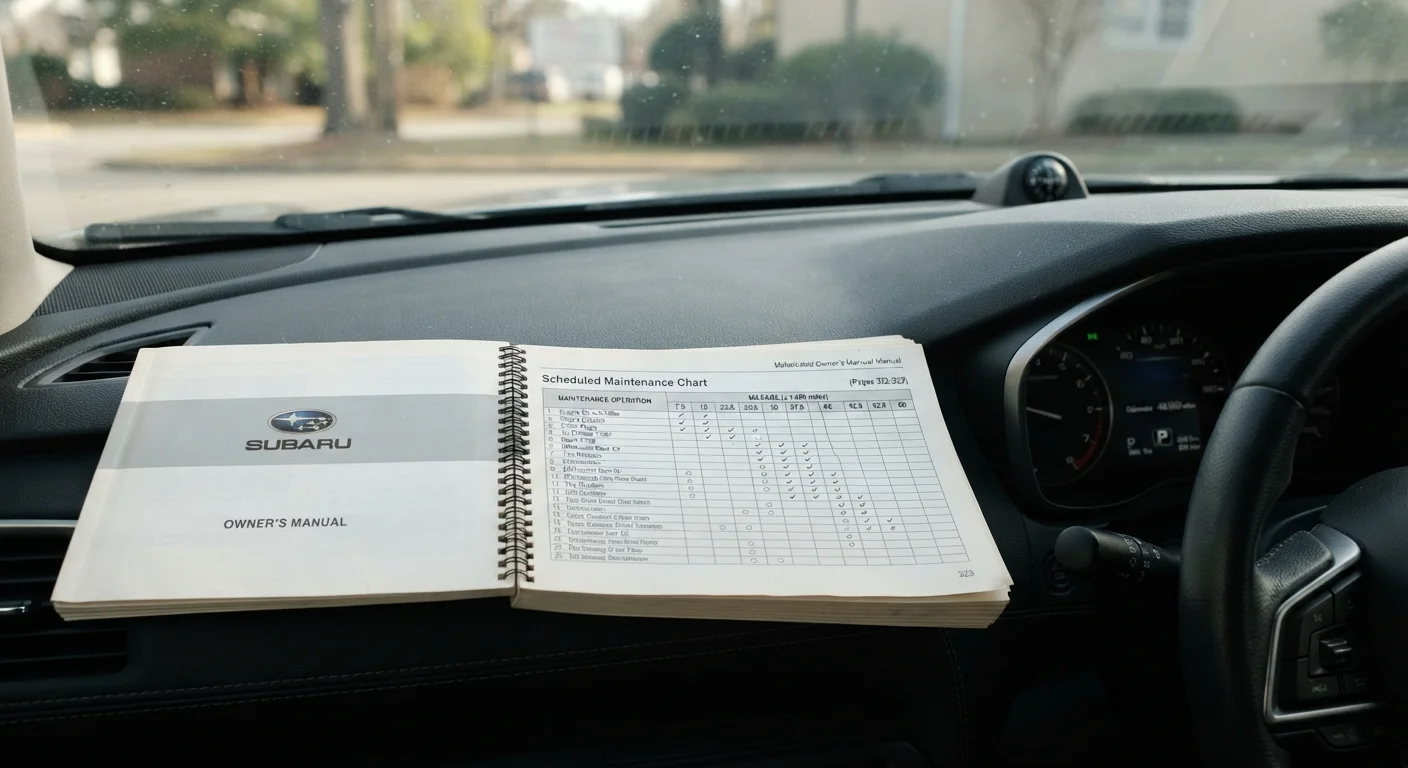
Flip to the maintenance section of your owner's manual and you'll find a table - sometimes two. It lists services down one axis and mileage or time intervals across the other. Common entries include engine oil and filter changes, tire rotations, air filter replacements, brake inspections, spark plug changes, coolant flushes, transmission fluid checks, and belt inspections.
Each service has a recommended interval expressed in miles (e.g., every 30,000 miles) or months (e.g., every 24 months), or both. The rule is simple: service at whichever comes first. A driver who covers only 5,000 miles a year still needs to change engine oil annually if the manual specifies 12 months - because oil degrades chemically even when the car sits.
For a broader look at what's physically happening under the hood, see our first-time owner's under-the-hood orientation.
35%
Drivers who skip or delay recommended maintenance
A Consumer Reports survey found roughly one-third of vehicle owners admit to postponing scheduled maintenance, citing cost concerns or uncertainty about what's actually needed.
$1,200+
Average cost of an engine repair from neglected oil changes
AAA estimates that oil-related engine damage - largely preventable through scheduled changes - can result in repair bills exceeding $1,200, far outpacing the cost of routine service.
2x
More frequent oil changes under severe-use conditions
Many manufacturers recommend oil change intervals roughly twice as frequent for severe driving compared to normal conditions, based on accelerated thermal and oxidative breakdown.
Normal vs. Severe Driving: Why It Changes Everything
Most owner's manuals include two maintenance tracks: one for normal driving conditions and one for severe. The severe schedule calls for shorter intervals across most services. What qualifies as severe often surprises drivers - it's not just towing a trailer or off-roading. According to manufacturer guidelines, severe use typically includes:
- Frequent trips under five miles, especially in cold weather
- Prolonged idling or low-speed driving in heavy traffic
- Operating in dusty or heavily salted road environments
- Sustained high-temperature conditions
- Towing, hauling, or carrying heavy loads regularly
In practice, a significant portion of urban and suburban drivers meet the severe-use definition at least part of the time. If your daily commute involves heavy stop-and-go traffic, your engine oil and brake pads are working harder than the normal schedule assumes. Check your manual's exact definition - it's usually a checklist, not a judgment call.
Use Both Triggers - Miles and Months
Don't wait until you've hit the mileage threshold if the time threshold arrives first. Engine oil, coolant, and brake fluid degrade chemically over time regardless of how far you've driven. Low-mileage drivers who ignore time-based intervals are just as vulnerable to preventable damage as high-mileage drivers who stretch their intervals.
How to Read the Schedule Table Without Getting Lost
The table format can look daunting, but it follows a consistent logic. Here's how to navigate it:
- Find your current mileage. Locate the column that corresponds to how many miles you've put on the vehicle since new (or since the last major service reset).
- Scan down the service rows. Every item marked in that column needs attention at or before that mileage.
- Cross-check against elapsed time. For any item with a time-based trigger, count months from the last service - not from when you bought the car.
- Note 'I' vs. 'R' codes. Many tables use 'I' for Inspect and 'R' for Replace. An inspection doesn't always mean a part gets swapped - it means a technician checks condition and flags it if worn.
Some newer vehicles replace the printed table with an onboard maintenance reminder system that calculates service needs based on driving data. Even so, the owner's manual remains the authoritative source - the reminder system typically tells you when, while the manual tells you what.
Dashboard warning lights can complement the schedule by alerting you to issues between service intervals - but they're not a substitute for preventive maintenance.
Turning the Schedule Into a Living Record
A schedule on paper only works if you track what's been done. Every time a service is completed, record the date, odometer reading, and the work performed - whether you did it yourself or a shop handled it. This log accomplishes three things: it tells you exactly when the next service is due, it prevents duplicate work, and it serves as documented proof of care if you ever sell the vehicle.
Our guide to keeping a car maintenance log walks through how to build and maintain this habit with minimal effort. And if cost management is on your mind, keeping maintenance costs in check over a vehicle's lifetime covers how proactive scheduling prevents small items from compounding into expensive repairs.
Seasonal conditions also affect how you prioritize the schedule - temperature extremes accelerate fluid degradation and stress batteries. See seasonal car care and weather preparation for what to check as conditions shift throughout the year.
This article provides general vehicle maintenance information for educational purposes. Always consult a qualified mechanic for diagnosis, repair decisions, and guidance specific to your vehicle's condition.
Frequently Asked Questions
It's in your owner's manual, typically in its own dedicated chapter. If you don't have a physical manual, most automakers publish them as free PDFs on their official websites. Search your vehicle's year, make, and model alongside 'owner's manual' to locate it.
Mileage-based intervals trigger service after a set number of miles driven - say, every 5,000 or 7,500 miles. Time-based intervals apply regardless of mileage - for example, every 12 months. Whichever threshold you hit first is the one that counts.
If your driving patterns match the severe-use definition in your manual - frequent short trips, heavy traffic, extreme heat or cold, towing - then yes. Ignoring it can accelerate wear on fluids and components beyond what the normal schedule accounts for.
Potentially, yes. Federal law (the Magnuson-Moss Warranty Act) protects your right to have service performed outside a dealership, but it does not protect you from warranty denial when manufacturer-required maintenance is skipped or undocumented.
A maintenance schedule is proactive - it sets intervals for routine service before problems occur. A repair list is reactive - it addresses issues that have already caused a failure or symptom. Sticking to the schedule is how you keep the repair list short.
No. Intervals vary significantly by manufacturer, engine type, and model year. A common example: some modern engines specify synthetic oil changes every 10,000 miles, while older designs may require every 3,000-5,000 miles. Always use your specific manual, not a generic rule of thumb.
The content provided on our blog site traverses numerous categories, offering readers valuable and practical information. Readers can use the editorial team’s research and data to gain more insights into their topics of interest. However, they are requested not to treat the articles as conclusive. The website team cannot be held responsible for differences in data or inaccuracies found across other platforms. Please also note that the site might also miss out on various schemes and offers available that the readers may find more beneficial than the ones we cover.