

Start here
How to Safely Open and Prop Your Hood
Next
A Map of What You're Looking At
Core skill
The Five Fluids Every Driver Should Check
Stay alert
Reading the Warning Signs
Know your limits
When to Call a Mechanic Instead
How to Safely Open and Prop Your Hood
Before you touch anything under the hood, the engine must be off and cool. A recently driven engine can hold temperatures well above 200°F - hot enough to cause serious burns if you contact metal surfaces or open fluid caps prematurely. Wait at least 30 minutes after driving, or check in the morning before the first trip of the day.
To open the hood:
- Locate the interior hood release - a lever or handle typically found low on the driver's side dashboard or beneath the steering column. Pull it until you hear a pop.
- Move to the front of the car and slide your fingers under the slightly raised hood to find the secondary safety latch, usually a small lever in the center. Push or pull it to release.
- Lift the hood fully and secure it with the prop rod if your vehicle has one, inserting the rod into the designated hole. Many newer vehicles use hydraulic struts that hold the hood automatically - give a gentle tug to confirm it's stable before reaching in.
Take a Photo Before You Start
Once the hood is safely propped open, take a photo of the engine bay with your phone. This gives you a personal reference point and helps a mechanic understand what you're describing if you call with a question later. It also makes it easier to spot anything that looks different next time you check.
A Map of What You're Looking At
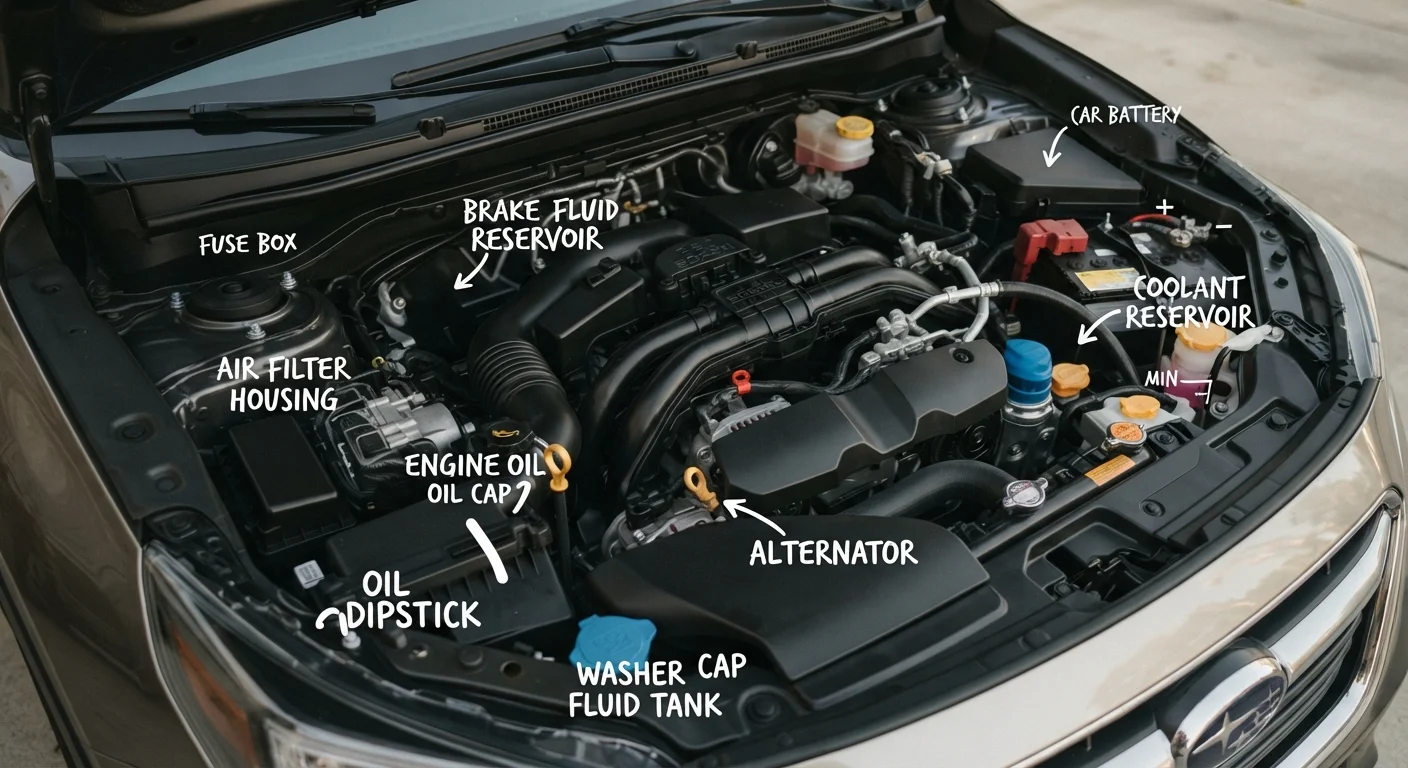
Engine bays look intimidating at first, but the layout follows a consistent logic. Your owner's manual will have a labeled diagram specific to your trim - keep it in the glove box and reference it freely.
Engine bay
The enclosed space under your hood that houses the engine and most major mechanical and fluid components.
Dipstick
A long, thin metal rod you pull from the engine to check the oil level and condition without opening any pressurized system.
Coolant reservoir
A translucent plastic tank that holds the mixture of antifreeze and water that regulates your engine's temperature.
Firewall
The metal barrier separating the engine compartment from the passenger cabin, designed to slow the spread of fire and reduce noise.
Gasket
A flat seal placed between two joined engine surfaces to prevent fluids or gases from leaking out at the joint.
Hydraulic struts
Gas-filled support cylinders that hold the hood open automatically on many modern vehicles, replacing the traditional manual prop rod.
Here are the landmarks you'll encounter in nearly every passenger vehicle:
- Engine block: The large, central metal mass. Most of what you'll check surrounds it rather than touching it directly.
- Oil fill cap and dipstick: The cap is usually marked with an oil-can icon; the dipstick is a looped handle you pull out to check oil level.
- Coolant reservoir: A translucent plastic tank, often on one side of the engine bay, with MIN and MAX markings visible from the outside.
- Battery: A rectangular box, typically black, with two cable-attached terminals marked + and −.
- Brake fluid reservoir: A small, translucent plastic container near the firewall (the wall separating the engine from the cabin), usually on the driver's side.
- Windshield washer reservoir: Identifiable by a spray-nozzle icon on the cap. Usually the largest reservoir in the bay.
- Air filter housing: A plastic box connected to a large duct leading toward the engine intake.
For a fuller reference on costs tied to these components, see our car ownership cost glossary.
The Five Fluids Every Driver Should Check
Routine fluid checks take under ten minutes and require no tools. Doing them monthly - or before a long road trip - is one of the most cost-effective maintenance habits you can build. Our detailed fluid types reference covers each fluid's role in depth; here's what to look for at a glance:
- Engine oil: Pull the dipstick, wipe it clean, reinsert fully, then pull again. The oil mark should fall between the MIN and MAX indicators. The color should be amber to brown - not black, milky, or gritty.
- Coolant (antifreeze): Check the level against the markings on the outside of the translucent reservoir. Never open this cap on a warm engine. Coolant is typically green, orange, or pink depending on the formulation your vehicle requires - check your owner's manual before adding any.
- Brake fluid: Look at the reservoir's external markings. If the level is low, don't simply top it off - low brake fluid can indicate worn brake pads or a leak, both of which need professional evaluation.
- Power steering fluid: Many newer vehicles use electric power steering with no fluid to check. If your car has a reservoir (often near the front of the engine bay), check the level and color - it should be clear to light amber, not dark or cloudy.
- Windshield washer fluid: The only fluid you can top off freely with no safety concerns. Use a washer fluid rated for the temperatures in your region to prevent freezing.
Understanding these service points also feeds directly into reading your vehicle's maintenance schedule intelligently.
Reading the Warning Signs
Your car communicates problems before they become failures. Learning to connect what you see under the hood with what you see on your dashboard closes that feedback loop. For a complete breakdown of dashboard indicators, see our guide to warning lights and what they mean.
Common physical signs to watch for when you open the hood:
- Oily residue on external engine surfaces: Could indicate a slow leak from a gasket or seal.
- Corrosion or white buildup around battery terminals: Normal over time but can cause starting issues if heavy. This is a job for a mechanic if you're unsure how to handle it safely.
- Cracks or brittleness in rubber hoses: Coolant and vacuum hoses degrade with age. Visible cracking warrants attention.
- Discolored or low oil on first check: If oil is dramatically low with no obvious leak, or is milky in appearance, have the vehicle inspected promptly.
Never Open the Coolant Cap on a Warm Engine
The cooling system operates under pressure. Opening the reservoir or radiator cap while the engine is warm or hot can release a blast of pressurized steam and scalding fluid. Always wait until the engine is fully cool - typically 30 minutes or more after you've stopped driving - before removing any coolant-related cap.
When to Call a Mechanic Instead
Knowing what falls inside your responsibility - and what doesn't - is just as important as any hands-on skill. Routine visual checks and topping off simple fluids are well within reach for any driver. The following are tasks that carry real risk if done incorrectly and should be left to a qualified technician:
- Anything involving the brake system beyond a visual fluid level check
- Battery replacement or jump-starting without proper knowledge (battery terminals can arc and cause injury)
- Any work on the cooling system under pressure
- Belt and hose replacement, which requires proper torque specifications
- Diagnosing or clearing a check engine light without a diagnostic scanner and mechanical knowledge
A multi-point inspection at a regular service visit covers most of these items systematically. Combining your own monthly fluid checks with professional inspections on your manufacturer's schedule - outlined in our complete driver's reference - gives you the best of both approaches: informed ownership without overstepping your lane.
This article is for general informational and educational purposes only. Always consult your vehicle's owner's manual and a qualified mechanic before performing any maintenance task you are unfamiliar with.
Frequently Asked Questions
Yes, opening the hood is safe as long as the engine has cooled down - typically 30 minutes or more after driving. Never open the coolant reservoir cap on a hot engine, as pressurized steam can cause burns. Always engage the hood prop rod or confirm the hydraulic struts are holding the hood up before reaching inside.
A monthly check is a reasonable habit for most drivers. If your vehicle is older or you've noticed any oil spots where you park, check more frequently. Always check with the engine off and the car on level ground for an accurate reading.
Fresh engine oil is amber or light brown. As it ages, it darkens to a deep brown or black. Oil that looks milky or has a foamy texture can indicate coolant contamination - that warrants a mechanic visit promptly.
Topping off engine oil, coolant (when cold), windshield washer fluid, and power steering fluid are tasks most drivers can handle safely. Brake fluid is trickier - low brake fluid can signal a leak or worn brake pads, so the underlying cause should be diagnosed before simply refilling.
Most vehicles have a hood release lever located on the driver's side, under the dashboard near the door. After pulling it, you'll feel the hood pop up slightly. A second safety latch under the front edge of the hood must also be released before the hood will fully open.
Note the color and location of the puddle - oil is dark brown or black, coolant is often green or orange and smells sweet, and brake fluid is clear to light yellow. Any active leak other than condensation from the air conditioning warrants a mechanic evaluation before your next long drive.
The content provided on our blog site traverses numerous categories, offering readers valuable and practical information. Readers can use the editorial team’s research and data to gain more insights into their topics of interest. However, they are requested not to treat the articles as conclusive. The website team cannot be held responsible for differences in data or inaccuracies found across other platforms. Please also note that the site might also miss out on various schemes and offers available that the readers may find more beneficial than the ones we cover.