

Why Cats Are More Trainable Than You Think
The idea that cats are untrainable is one of the most persistent myths in pet ownership. Cats are highly intelligent, curious animals capable of learning a wide range of behaviors - they simply learn differently from dogs. Where dogs are motivated by social approval, cats are primarily motivated by self-interest: food, play, and environmental comfort.
That distinction is actually an advantage. It means that once you understand what your cat values, you have a reliable lever for behavior change. Applied animal behaviorists have documented cats successfully learning to sit, come when called, use a scratching post on cue, accept handling, and even navigate obstacle courses - all through methods grounded in the same behavioral science used for dogs and other animals.
If you're approaching this from a dog-training background, it helps to read our first-time dog training guide alongside this one to appreciate how the underlying principles overlap - and where they diverge.
The Science Behind Cat Training
Cat training is rooted in operant conditioning - the process by which an animal learns that its own behavior produces consequences. When a behavior is followed by something the animal wants (a reward), that behavior becomes more likely to repeat. This is called positive reinforcement, and it is the cornerstone of humane, effective cat training.
Punishment - including spray bottles, loud noises, or physical correction - is not recommended by veterinary behaviorists. It doesn't teach a cat what to do, it erodes trust, and it can increase stress-related problem behaviors.
A key tool in operant conditioning is a marker signal: a distinct sound (often a clicker, or a consistent word like "yes") that tells the cat precisely which behavior earned the reward. Because cats have fast reaction times and short attention windows, that split-second precision makes a meaningful difference in how quickly learning occurs.
To get comfortable with the terminology used throughout cat and pet training, our plain-language training glossary is a useful companion reference.
Always end each training session on a behavior your cat can perform successfully - even if it's just a simple sit. Finishing on a win keeps your cat's motivation high for the next session.
Ending on success leverages the recency effect in memory consolidation and helps cats associate training with positive outcomes rather than frustration or difficulty.
When introducing a new cue word, say it only once immediately before the behavior happens - never repeat it while waiting. Repeating a cue teaches the cat that the word is meaningless until the fifth time you say it.
Behavioral research across species consistently shows that prompt repetition undermines stimulus control, making it harder for the animal to form a clean association between the cue and the behavior.
Setting Up for Success Before You Begin
Effective training starts before the first session. Environment, timing, and tools all affect how quickly your cat learns and how willingly it engages.
- Choose the right reward: High-value treats - small pieces of cooked chicken, commercially prepared meat-based treats, or whatever your individual cat goes wild for - work best. Dry kibble rarely generates enough motivation for active training.
- Train before meals, not after: A slightly hungry cat is a more engaged cat. Avoid training within an hour of a full meal.
- Minimize distractions: Start in a quiet, familiar room. Other pets, children, and loud sounds all compete for your cat's attention.
- Keep sessions short: Three to five minutes is often ideal, especially when starting out. Ending while your cat is still engaged beats pushing past the point of interest.
Our pre-session readiness checklist covers the full setup process in detail and is worth reviewing before your first attempt.
Start With One Skill at a Time
Resist the urge to work on multiple behaviors in a single session when you're just starting out. Introducing too much at once makes it harder for your cat to form clear associations. Pick one behavior, practice it until it's reliable, then add the next. Building a solid foundation on a few skills transfers better than shallow familiarity with many.
Core Skills to Teach Your Cat
Start with behaviors that build a foundation of communication and cooperation, then expand from there.
Sit
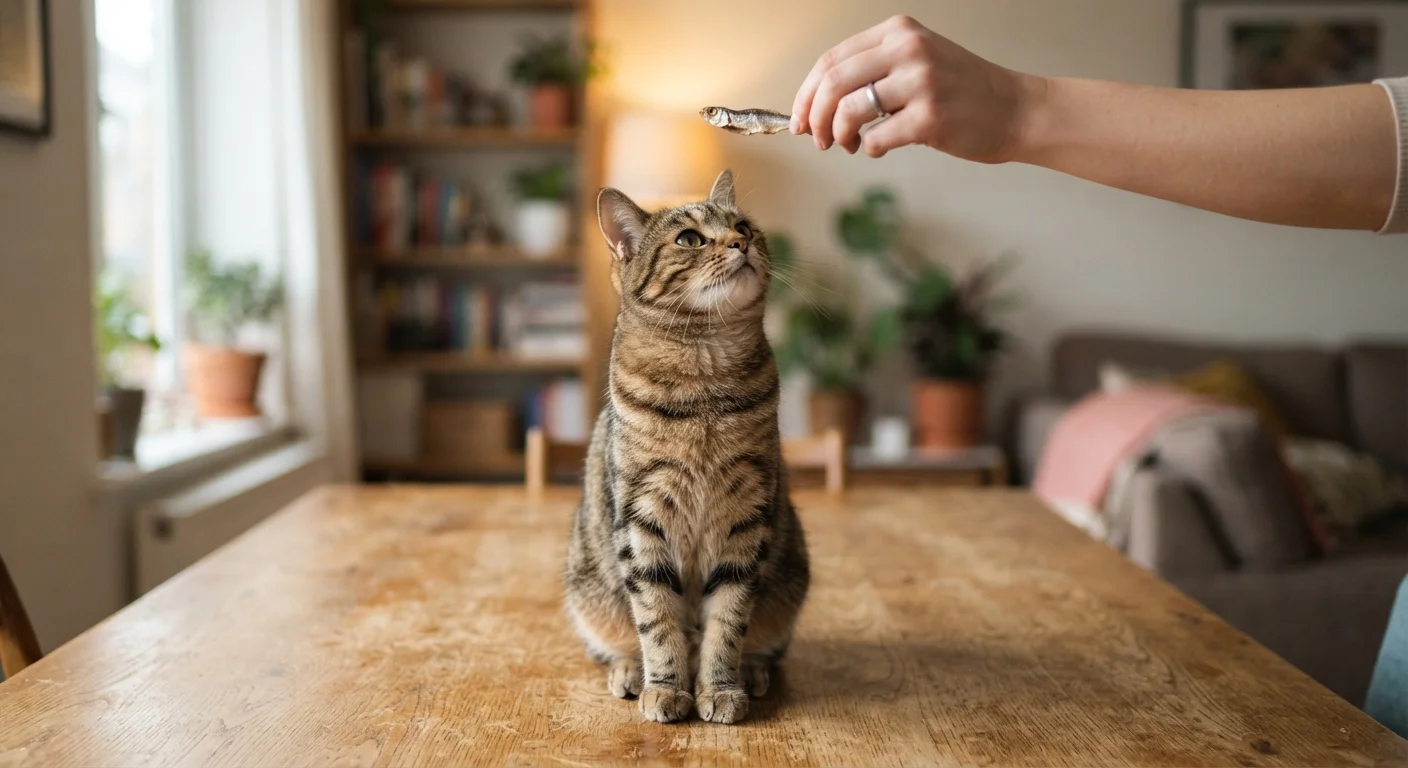
Hold a treat just above your cat's nose and slowly move it back over its head. Most cats will naturally lower their hindquarters as they follow the treat. The moment their rear touches the floor, mark the behavior and deliver the treat. Practice this 5-6 times per session before adding a verbal cue.
Come When Called
Begin by associating your cat's name with something positive: say the name, then immediately offer a treat. Once the cat looks toward you reliably, add a step back and reward it for moving toward you. Build distance gradually over multiple sessions.
Target Training
Target training - teaching a cat to touch its nose to a target stick or your fingertip - is a foundational skill that unlocks more complex behaviors. Mark and reward any nose contact with the target, then begin moving the target to guide the cat through positions or spaces.
Carrier Comfort
Cats that associate the carrier with vet visits often resist entering it. Desensitize by leaving the carrier open in a common area with bedding inside, feeding meals near it, then gradually inside it. This process may take days to weeks depending on the cat's history.
For a deeper look at how to structure these skills into productive practice routines, see our guide on structuring training sessions that actually stick.
3-5 min
Ideal cat training session length
Animal behaviorists generally recommend keeping feline training sessions brief to match cats' natural attention windows and sustain engagement.
~74%
US households reporting at least one pet
According to the American Pet Products Association's National Pet Owners Survey, pet ownership remains widespread, with cats among the most common companions.
Troubleshooting Common Problem Behaviors
Problem behaviors in cats are rarely spite or stubbornness - they almost always have an identifiable cause. Addressing the root is far more effective than trying to suppress the behavior directly.
Scratching Furniture
Scratching is a normal feline behavior that serves communication, claw maintenance, and stretching functions. Redirect it by placing appropriate scratching surfaces (posts, pads) next to the areas being targeted. Rewarding use of the post with treats and play accelerates the shift.
Nighttime Activity and Vocalizing
Cats are crepuscular - most active at dawn and dusk. Nighttime disruption often signals insufficient daytime enrichment. Structured play sessions in the evening can reduce restlessness at night.
Litter Box Avoidance
When a cat stops using its litter box, the cause can be medical (urinary tract issues, pain), environmental (box location, type, cleanliness), or social (stress from another pet). Always rule out medical causes with a veterinarian first. Our detailed litter box troubleshooting guide walks through this process step by step.
Aggression During Handling
Cats that bite or scratch during handling often have a low tolerance threshold built up through past experiences. Systematic desensitization - brief, calm touch paired with high-value rewards, gradually extended over time - rebuilds tolerance. If aggression is sudden or severe, consult a veterinarian to rule out pain as a cause.
Never Use Punishment-Based Correction
Methods such as spray bottles, loud startling noises, or physical correction may suppress a behavior momentarily but do not teach the cat what to do instead. More importantly, they introduce fear and stress into the cat's environment, which can worsen problem behaviors and damage the human-animal bond. Veterinary behaviorists consistently advise against aversive techniques in cat training.
Keeping Training Consistent Over Time
Inconsistency is the most common reason cat training stalls. If one household member allows a behavior that others are discouraging, the cat receives conflicting signals and the training breaks down. All adults in the home should use the same cues, the same rules, and the same reward approach.
Maintenance practice - brief, occasional reinforcement of learned skills - prevents behaviors from fading. A 2-minute sit-and-come refresher every few days is often enough to keep a skill solid.
Training also intersects with your cat's broader health and wellbeing. A cat that is nutritionally well-supported, mentally stimulated, and physically comfortable is a more responsive learner. Our cat nutrition overview and pet health basics hub offer foundational context for keeping your cat in the condition where learning thrives.
Training is not a one-time event - it's an ongoing relationship with your cat built on clear communication, patience, and mutual trust. The effort you invest in the early stages compounds over the life of the animal.
This article is for general informational and educational purposes only. It does not constitute veterinary or behavioral advice. If your cat is showing signs of illness, injury, or severe behavioral disturbance, consult a licensed veterinarian or a certified applied animal behaviorist.
The content provided on our blog site traverses numerous categories, offering readers valuable and practical information. Readers can use the editorial team’s research and data to gain more insights into their topics of interest. However, they are requested not to treat the articles as conclusive. The website team cannot be held responsible for differences in data or inaccuracies found across other platforms. Please also note that the site might also miss out on various schemes and offers available that the readers may find more beneficial than the ones we cover.